This Saturday, November 14, two free events share one afternoon in Griffith Park, and they meet in different places. The Sunset Walk & Talk gathers at the Greek Theatre's lower lots on Vermont at 3:30 p.m. The monthly Public Star Party opens on the Observatory lawn at 2:00 p.m. and keeps its telescopes pointed up until 9:45 p.m. Most people who come in from across the city will pick one and drive to it.
The Oaks has a better option. The hills between Fern Dell and the Greek are close enough that the whole evening works as one route, and the piece that holds it together is a city shuttle with stops on Franklin Avenue and Hillhurst. The car is what makes the night hard.
The walk finishes at the bottom of the hill
The Observatory's monthly Sunset Walk & Talk is led this month by Senior Urban Ecologist Brian Rawles, Junior Urban Ecologist Ryan Kinzel and Griffith Observatory staff. Here is how the Observatory's own event page describes the route:
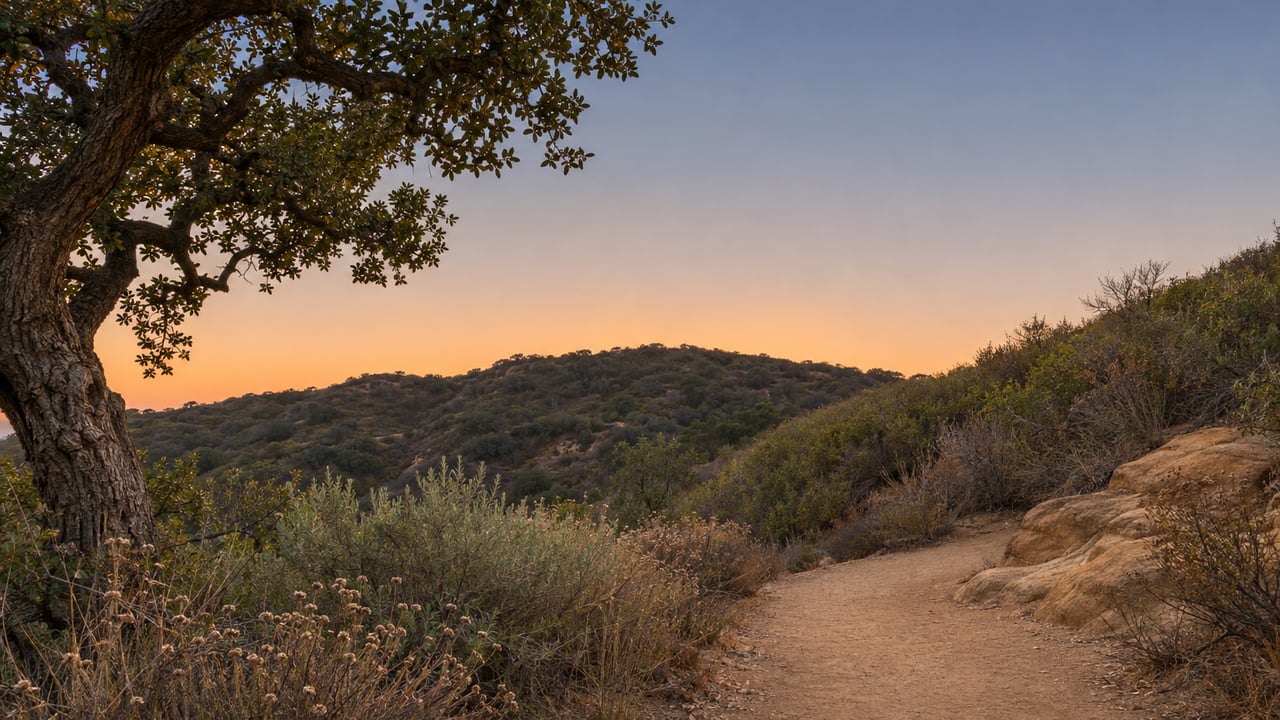
"The hike starts at the Greek Theatre, continues up the Boy Scout Trail to the Berlin Forest and then returns to the Greek Theatre via East Observatory Road. The distance is 2.25 miles with an elevation of 375 feet over the course of about two and a half hours at a moderate pace."
The page also warns of steep inclines, with stops along the way to talk about the park's history and whatever is coming out in the evening sky. The group meets at Greek Theatre Parking Lot F/G, 2700 North Vermont Avenue, and parking there is first come, first served. The ticket is free, but you need to RSVP through the Los Angeles Parks Foundation before Saturday. That page asks walkers to gather at the south entrance to Lots F/G and makes donations optional.
Pay attention to where the walk ends. It wraps up at 6:00 p.m., back at the Greek, a few hundred feet below the Observatory, with darkness already falling. Sunset in mid-November comes before 5:00 p.m. The Observatory's November Sky Report puts it at 5:00 p.m. on the 1st and 4:44 p.m. on the 30th. So by the time the group gets back down East Observatory Road, the telescopes up top have had about an hour of real dark to work with.
Almost four hours of telescopes after the walk
The Public Star Party is free. Volunteers from the Los Angeles Astronomical Society, the Los Angeles Sidewalk Astronomers and The Planetary Society bring telescopes to the lawn, and the Observatory says the night can include the Sun, the Moon, any visible planets and other objects. Telescope lines are cut off so that viewing wraps up by 9:45 p.m., the building closes at 10:00 p.m., and you can't bring your own telescope.
Walkers who finish at 6:00 p.m. still have almost four hours of telescope time ahead. Here's what the November Sky Report suggests will be up during those hours:
- A thin Moon. It's new on November 8 and reaches first quarter on November 17, so Saturday's Moon is a young waxing crescent.
- Saturn. It sits in Cetus this month and sets after midnight all November: 3:55 a.m. on the 1st, 1:55 a.m. on the 30th. A telescope at 50x shows the rings and Titan, Saturn's largest moon.
- Uranus. It's in Taurus and rises in the early evening, at 6:16 p.m. on the 1st and 4:18 p.m. on the 30th. Its disk is tiny and needs 150x or more, so it's a good one to ask a volunteer about.
- Southern Taurid meteors. November 14 is the shower's annual peak. It rarely produces more than five meteors an hour, but many of them are bright fireballs.
Jupiter and Mars are the big names in Leo this month, but neither rises until late night, after the lawn has cleared. For a Jupiter night, the December 19 star party is a better bet, with the same 2:00 to 9:45 p.m. hours and the same three volunteer groups.
Why driving is the hard part on this kind of night
The Observatory's Getting Here page is blunt about it. Parking is limited and busiest on evenings and weekends. Fees apply at the public lot, along West Observatory Road and on Western Canyon Road during posted hours, and you pay at pay-and-display stations with no refunds. When traffic backs up, road closures are likely. Even inside, capacity controls can mean waits of 5 to 15 minutes. City Recreation and Parks adds that parking fees go up in peak seasons and around holidays.
A Saturday star party with a free hike starting below it is exactly the evening that warning describes. The car also creates a second problem. If you park at the Greek for the walk, it's still sitting in Lot F/G at 6:00 p.m. while the telescopes are uphill. Moving it means trying for a second space just as the evening crowd arrives, and if you leave it where it is, you'll be walking back down to it in the dark after 9:45.
The same page encourages hikers to use the trails that start near Fern Dell or the Greek Theatre. For The Oaks, both trailheads are close to home, which leaves you needing only a way between them.
The shuttle stops are already on your street
The DASH Observatory/Los Feliz route runs every day of the year, holidays included. Its stops include Franklin Avenue at Vermont, Hillhurst at Franklin, Los Feliz Boulevard at Hillhurst, the Greek Theatre and the Observatory itself, with the southern end at the Vermont/Sunset Metro station. The fare is 35 cents with a TAP card or 50 cents cash. Seniors, riders with disabilities and Medicare cardholders pay 25 cents cash or 15 cents with TAP, and up to two children age four or younger ride free with a paying adult. LADOT's weekend timetable shows Observatory departures about every 15 minutes, with the last listed bus leaving at 10:06 p.m. Schedule times can shift with traffic and weather, so check the live map before you count on the last bus.
Put together, Saturday runs like this for someone starting near Franklin:
- Around 3:00 p.m. Board DASH at Franklin and Vermont or Hillhurst and Franklin and ride to the Greek Theatre stop.
- 3:30 p.m. Check in at the south entrance to Lots F/G for the Sunset Walk & Talk.
- About 4:45 to 5:00 p.m. Watch the sunset from somewhere on the Boy Scout Trail and Berlin Forest loop.
- 6:00 p.m. The walk ends at the Greek. Catch the next DASH uphill to the Observatory.
- 6:15 to 9:45 p.m. Telescopes on the lawn. Saturn and the crescent Moon early, and keep looking up for a Taurid fireball.
- By 10:06 p.m. Take the last listed DASH back down to Franklin.
Three rides add up to $1.05 per adult with TAP or $1.50 in cash, and you never have to find a parking space.
The rest of the dark season
The same plan works for the next two months, with a couple of calendar changes. The Observatory is open 10:00 a.m. to 10:00 p.m. on weekends and closed every Monday. It's also closed on November 26 and December 25, and it closes at 5:00 p.m. on December 24 and December 31.
- Saturday, December 19. The next Public Star Party, 2:00 to 9:45 p.m.
- Monday, December 21. The December Sunset Walk & Talk, 3:30 to 6:00 p.m., on the same Greek Theatre route. The Parks Foundation bills it as a Winter Solstice hike with urban ecologists and Observatory astronomers. The ticket is free, but you need to register. The building itself is closed that Monday, but the walk starts and ends at the Greek, so it isn't affected.
- November 20 through January 10. L.A. Zoo Lights brings new light installations, seasonal food and drinks, carolers on select nights and a separately ticketed skating rink to the other side of the park. Tickets start at $19 and parking is free. December 8 is a sensory-inclusive night and December 17 is Pride Night. The event is dark on November 26 and 30 and on December 1, 7, 14, 15, 16, 24, 25 and 31.
Zoo Lights is the ticketed option in the bunch. The two Observatory dates are free, and each one starts with a walk you can reach from Franklin on a shuttle.
Living a short ride below the Observatory lawn is part of what makes The Oaks The Oaks. If you're thinking about what a home that close to Saturday's telescopes is worth, Your Spot LA can put together a home valuation built around the details that make your street yours. Find your spot, and we'll help you see what it's worth.